
The Fire That Transforms
Fire has always held a special place in Hindu traditions. It gives light and warmth, but it also transforms everything that enters it.
A piece of wood becomes flame. Ghee disappears into the fire. Herbs and other offerings are transformed into fragrance and smoke. What we place into the fire does not remain the same.
Perhaps this is one reason fire is such a meaningful symbol.
Havan can remind us that transformation is a part of life.
We all carry things within us that we would like to change. Sometimes it is anger. Sometimes it is jealousy, fear, insecurity, impatience or pride. Sometimes it is simply something from our past that we keep holding on to.
What if Havan gives us a way of thinking about those things differently?
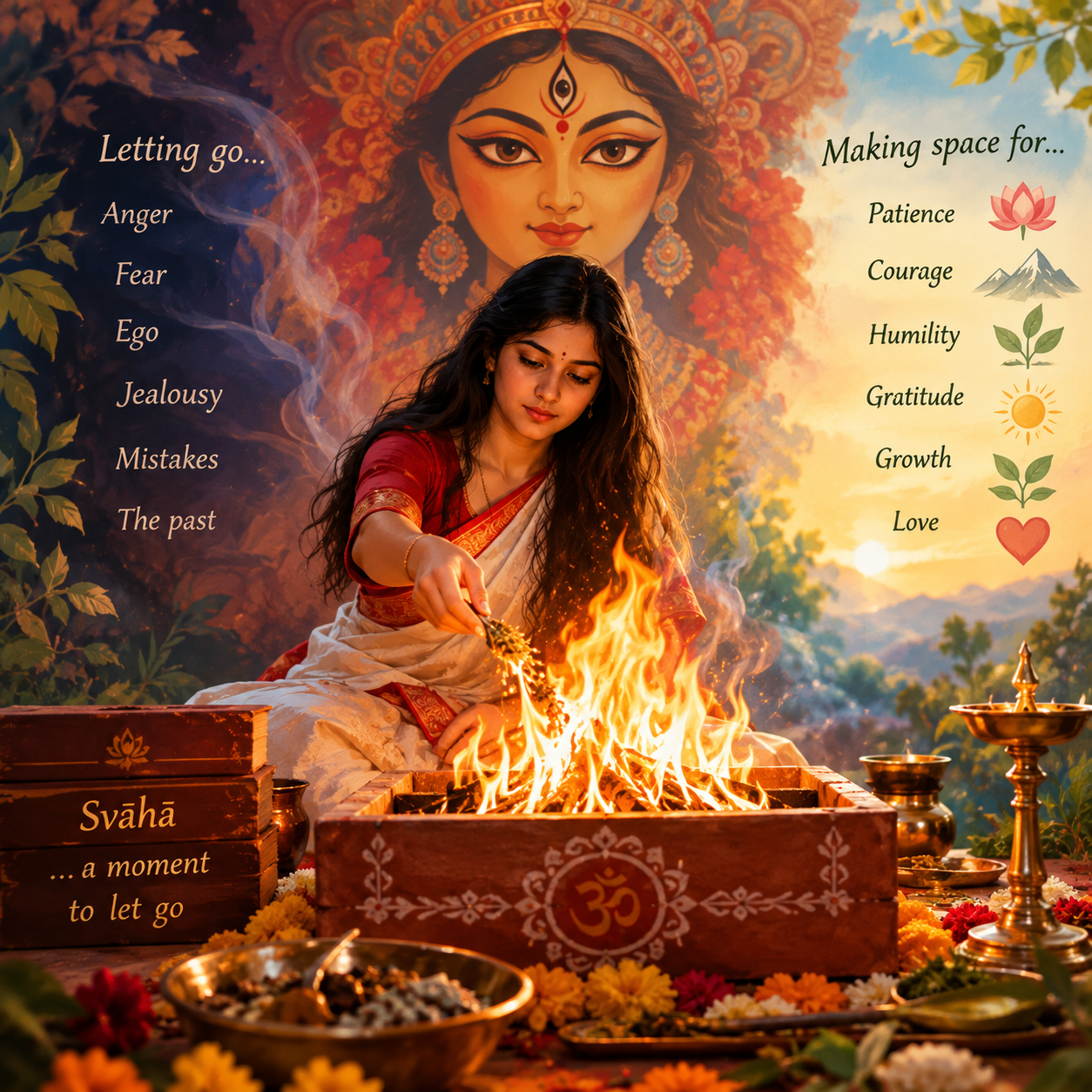
What if, along with the physical offerings we place into the fire, we also symbolically offer our weaknesses?
We could offer our anger and make space for patience.
We could offer our fear and make space for courage.
We could offer our ego and make space for humility.
We could offer our jealousy and make space for gratitude.
We could offer our mistakes—not to pretend they never happened, but to learn from them.
In this way, the fire of Havan becomes more than something we see outside ourselves. It becomes a reminder of a fire within us—the ability to transform who we are.
Agni: The Messenger
The sacred fire in a Havan is associated with Agni, who occupies a central place in Vedic tradition. Agni is not simply ordinary fire. In the ritual context, Agni receives the offerings and carries them toward the divine.
This gives the act of offering another beautiful meaning.
When we offer something, we are also learning to let go.
We spend so much of our lives holding on—to possessions, opinions, expectations, disappointments and even old arguments. We often think that holding on makes us stronger. But sometimes strength means knowing when to release something.
The moment an offering enters the fire, we no longer control what happens to it. We trust the process of transformation.
Perhaps that is also a lesson for us.
We cannot control everything that happens in our lives. We cannot control every outcome, every person or every circumstance. But we can choose what we bring to the moment—our intentions, our actions and the attitude with which we face life.
What Does “Svāhā” Mean to Me?
During Havan, we often hear the word “Svāhā” as each offering is placed into the fire.
To me, it can represent a moment of release—a moment when we say, in effect, I am willing to offer this and let it go.
Imagine if we could bring that attitude into everyday life.
Instead of carrying anger from yesterday into today, could we let it go?
Instead of constantly comparing ourselves with others, could we learn to appreciate our own journey?
Instead of being afraid of making mistakes, could we see mistakes as opportunities to grow?
These may seem like small changes, but perhaps transformation always begins with something small.
Havan and the Shakti of Durga
This becomes especially meaningful during Durga Puja.
We celebrate Maa Durga as Shakti—the divine power and energy that creates, protects and transforms. She is depicted with many forms of strength: courage, compassion, wisdom and the determination to overcome forces that threaten what is right.
But Shakti does not have to remain something we see only in a deity or a temple.
We experience forms of Shakti every day.
It is the courage to speak up when something is wrong.
It is the strength to keep going when something is difficult.
It is the compassion to help someone who needs us.
It is the wisdom to know when to listen.
It is the ability to stand back up after we fall.
Perhaps this is one of the deeper connections between Havan and Durga Puja. The fire reminds us that transformation is possible, while Maa Durga reminds us that we have the strength within us to transform.
The Havan of Everyday Life
Maybe the spirit of Havan does not end when the fire goes out.
A student helping a classmate understand something is making an offering.
A parent giving time and patience to their child is making an offering.
Someone volunteering in their community is making an offering.
A person forgiving someone, even after being hurt, may be making an offering.
Whenever we give something of ourselves without expecting something in return, we are practicing the spirit of offering.
This makes Havan surprisingly relevant to our lives today.
We live in a world that often tells us to collect—to collect achievements, followers, possessions, awards and attention. Havan reminds us of another possibility: to give.
Not everything valuable has to be possessed.
Some things become more meaningful when they are offered.
So, What Are We Really Offering?
The next time I sit before the Havan fire during Durga Puja, I hope I will see it a little differently.
I will still see the beautiful flames, hear the mantras and watch the offerings disappear into the fire. But I will also try to think about what I can offer from within myself.
Perhaps I can offer a little less anger.
A little less ego.
A little less fear.
And perhaps I can offer a little more courage, kindness, gratitude and love.
The true beauty of Havan may not be in what happens to the offering after it enters the fire. Perhaps it is in what happens to us when we learn to offer.
We enter the ritual holding something in our hands, and we place it into the flames. But perhaps we are meant to leave carrying something different in our hearts.
The fire transforms what we give it.
And perhaps that is the quiet invitation of Havan:
to place our limitations into the fire and allow the Shakti within us to transform them into strength.
Because maybe the most meaningful Havan is not the one in which we offer the most to the fire, but the one in which the fire changes us.